

Desk heights for saddle-sitting are several inches higher than for conventional seating. Therefore, it is important to adjust your saddle seat to the correct height first. After you determine your correct sitting height, raise your desk to a comfortable height for working.
If you normally work at a traditional office or computer desk, you need to raise it quite a bit to benefit from saddle sitting. Place a shim under the desk legs (for example, using Raise Its™, wood, or bricks) or use a riser to raise your computer screen and keyboard.
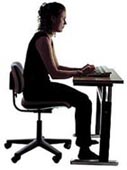
Desk height for a conventional chair is lower.
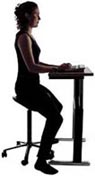
Desk height for a saddle seat is higher.
If you usually work on a high drafting stool or in a standing posture, you may be able to switch to a saddle seat with little or no adjustment of your working height.
Your hand tasks should be approximately at the level of your elbows, give or take, depending upon the task. Visually demanding hand-tasks are positioned a few inches higher, and hand tasks requiring some force (e.g, gripping, pounding, twisting) are positioned a few inches lower.
- Touch typists who can type without looking at the keyboard, can position their keyboards at or below elbow height.
- Typists who must see the keyboard to type accurately, must position their keyboards a few inches above the elbows and further away from the body, in order to bring the keyboard into view.
- Paper-handling and reading tasks are generally 2″ or more above elbow height.
- For visually demanding tasks, for example reading or fine hand work, the desk can be several inches higher.
- If your desk is not height-adjustable, you can raise it with bricks or boards or purchase commercial desk risers (i.e. Raise Its.
- If you work without a desk, adjust your hand-task so that you don’t need to bend over at all.
Leave a Reply
Your email is safe with us.